
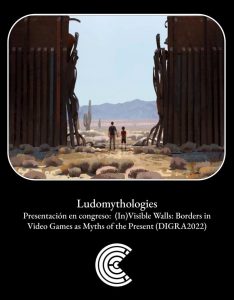
Recopilamos aquí las presentaciones en congresos vinculadas al proyecto. Empezamos con:
“(In)Visible Walls: Borders in Video Games as Myths of the Present (DIGRA2022)”
Autores: Beatriz Pérez-Zapata y Víctor Navarro-Remesal
Congreso: DiGRA2022 (Cracovia)
DOI: https://doi.org/10.26503/dl.v2022i1.1401
https://dl.digra.org/index.php/dl/article/view/1401
Extended abstract:
In 2013, Papers, Please(Lucas Pope) made players take on the role of a border agent of a fictional ex-soviet country who checks passports, visas, and other permits, thus presenting ethical dilemmas built on the clash between a changing migration policy and the needs of individuals. By turning border procedures into a playable system, Papers, Pleasegave the medium a template to discuss and challenge the topic. The past decade has seen a growing trend of video games about borders and immigration, with many of them inspired, directly or indirectly, by Papers, Please. In this paper, we analyze three of these cases: the “Immigration” duo by creator and activist Creatrix Tiara, What the $!#&@! Do They Need Now?(2017) and Here’s Your Fuckin’ Papers(2017), Borders (Gonzalo Álvarez, 2017), and Not Tonight(Panic Barn, 2018). We will analyze the formal tools of the medium they use to create their discourse, their framing as activist works of resistance, and their representation of the migrant subject as having subjectivity and agency. To do so, we use the conceptual framings and methodologies of postcolonial game studies and mythanalysis, understanding these games as “myths of the present” that allow us to read how ideological discourses separate communities and how these can be brought together. Beyond tradition and ritual, myths can be understood as “any story that can transcend, be repeated, give rise to new stories, or even be the origin of new myths” (Martínez García 2017, 29). Myths of the present have an immanent nature by being born out of a specific context, and create a new mythical genesis for social, political, and cultural bonds, as Barthes (1957) explained. Video games can reflect these immanent myths as well as contribute to their ongoing articulation. Contemporary migration stories owe as much to the transcendent myth of Homer’s Odysseyas to tales of refugees’ ordeals, suffering, and hopes in games such as Bury Me, My Love(Pixel Hunt, 2017) and Path Out(Causa Creations, 2017).
Postcolonial refugee games have largely focused on history, identity, and cultural and social discourses (Mukherjee, 2017; Raessens, 2015; Navarro-Remesal and Pérez Zapata, 2019). However, video games that address migration have not been studied through the relation of borders and myth making. Borders, connected to notions of sovereignty, political re-configuration, nostalgia, and “imagined communities” (Anderson 1983), are established around the confrontational binary us vs. them, and have been redefined in the 20thcentury, as Ricardo Zapata-Barrero argues, by the “exit option”, or the right to leave one’s country (2004). Contemporary debates on refugees and asylum seekers are centred on the right to enter and discourses on human rights have shifted towards the challenges posited by geopolitics and democratic membership. The problem can be better understood by discussing Robert Dahl’s questions on “inclusiveness” (1989): a democratic nation is built upon the representation of its demos, but when a part of the population is not included in that demos, we have people who is subject to the common rules but has no sovereignty whatsoever. Accordingly, the matter with borders is not only who can cross them to get in and stay in, but who has citizenship rights once inside them. Video games have reflected questions of citizenship and belonging and challenged and participated in their underlying immanent mythical structure. This project analyses three examples to illustrate how borders and myths (de)construct these issues: Creatix Tiara’s “Immigration” offers experimental pieces that deal with “migration policy, international study, [and] the effect of immigration systems on mental health and livelihood” (n.d); Gonzalo Álvarez’s Bordersconstitutes “political art game” where players control a Mexican migrant trying to cross the border with the US using stealth mechanics; Not Tonightis a simulation game contextualized in around Brexit. By using conceptual tools from game studies such as the notions of “critical play” (Flanagan, 2009) and contemporary theoretical and analytical approaches to the study of refugeedom (Cox et al., 2020), we interpret these games not only as acts of resistance that seek to challenge anti-immigration views in potential host countries such as the US and the UK, but also as pieces of a wider modern mythical structure about displacement, refuge, belonging, and togetherness.
Comentaris recents